


Calcalist, Dror Marmor, 04.03.2021
The rating company S&P Maalot estimates that housing prices in Israel will rise by 4% this year, similar to the rate of increase in 2020 ( according to data from the Central Bureau of Statistics ), and in 2022 the increase is expected to moderate to 3% -2%, Calcalist has learned. . The forecast regarding the Israeli market is attached to a review by the international rating company regarding the housing market in Europe.
“In Israel, apartment prices rose at a rapid pace in 2020 due to relatively stable demand and limited supply. Unlike in Europe, in 2021 we expect that in the scenario of economic recovery and the continued decline in the supply of housing, a similar rise in housing prices is expected. At the end of 2020, there will be a significant reduction in the supply of unsold apartments, which may even worsen due to the decline in construction starts, "said Gil Avrahami, director of entrepreneurial real estate and contracting at S&P Maalot.
And can the transition to work for many from home reduce the desire of most Israelis to live in the heart of areas of demand? S&P Maalot estimates that “as in Europe, we assume that the large cities will remain attractive and the focus of demand for housing, even in the event that work from home becomes more common. Here, too, employment, leisure, culture and health services are important in determining the place of residence. ”
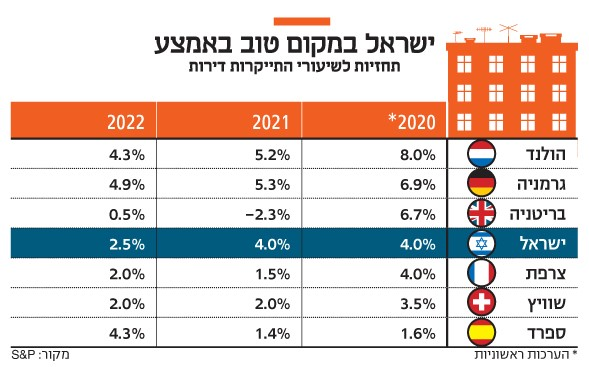
After the sharp rise in prices in most European countries over the past year, it is expected that housing prices in Europe will grow at a slower pace in 2021, and in two countries, the United Kingdom and Italy, prices are expected to fall by 2.3% and 0.5% respectively.
S&P emphasizes that European countries' treatment of the corona crisis has raised demand in the housing industry, and with it prices, especially in the second half of 2020. Following the epidemic, people have seen the value of an apartment owned, so "home purchase intentions are now highest 2003 ".
At the same time, the supply of construction of new apartments decreased due to the restrictions of closures, while the interest rate policy of the central banks and the assessment that the low interest rate environment will be with us for a long time made it easier to take out mortgages and buy real estate.
In addition, most countries 'policies protected workers' jobs, kept their incomes and removed quite a bit of uncertainty. As a result, savings have climbed to unprecedented levels, especially in the established strata, in part due to store closures and a ban on flights, which is fueling demand for the housing market.
At the same time, some countries will also encourage the purchase of apartments. In Israel, for example, they reduced the purchase tax for investors, made it possible to increase the prime component of mortgages and approved a postponement of loan repayments . In the UK they raised the first tier to pay stamp duty when buying real estate, and in Sweden mortgages were granted.
However, the rating agency emphasizes that the economy will not return quickly to the pre-epidemic growth rate by mid-2022, nor is a recovery in employment data expected any time soon. As a result, the abnormal growth of the housing market in 2020 may fade, and housing prices will grow more slowly in 2021. At the same time, banks may worsen lending conditions, and "price-to-income and rental-price ratios already indicate overestimation in most markets."