


The Marker, Adi Cohen, 16.03.2021
Their ambitious housing goals will be required by the state in the coming decades and the exacerbating shortage of land for construction is pushing planning institutions to look for solutions even underground. Subject to the decision of the National Planning Council, the state has been formulating these solutions for about two years into the national master plan for the protection and development of the underground space in Israel (NOP 40) - which is intended to stimulate the real estate market for planning and construction underground.
Today (Tuesday) the Planning Administration is supposed to put the first chapters of the plan on the table of the Volta'a (the subcommittee on planning issues of principle of the National Council) - and from them it appears that underground construction may in the not too distant future become a practical obligation in construction projects in large cities The state points to the construction of malls, cinemas, sports halls and even offices in the underground space - as a matter of necessity.
In the first phase, the emerging plan is expected to require local authorities to prepare policy documents, which will identify and define complexes with potential for underground development in their area - along with the construction volumes and uses that will be made possible. In these complexes, especially in densely populated urban areas, the state is considering requiring developers to build underground as a condition for exercising their rights to the heights above the ground. Authorities will also be required to mark "wasted" built-up areas that can be vacated and relocated underground - such as overhead parking lots, movie theaters and banquet halls.
When it's deep
Uses that will go underground
• Cinemas
• Malls
• Public parking
• Storage and logistics buildings
• Sports facilities
• Banquet halls
• Offices
• Infrastructure tunnels
Entrepreneurs' commitment to underground development will also be examined in the context of urban renewal projects , which will examine the possibility of including the underground areas as part of the allocations to their public areas that the developers will be required to make. According to the Planning Administration, this will free up surface areas for development in these projects - which will contribute to their economics.
The plan defines the uses that the state strives to incorporate in the underground space, depending on the extent to which they are located on the ground - including storage and logistics areas, parking lots, public institutions, sports facilities, commercial areas and offices.
Two other uses that are highlighted in the program are underground infrastructure and cemeteries. According to the emerging plan, cemeteries to be built in the future, and extensions to existing ones, are expected to go underground, and burial will be done in them on floors. With regard to infrastructure, the plan points to the need to consolidate underground infrastructure through infrastructure tunnels - thus, it is estimated, hundreds of thousands of dunams will be vacated.
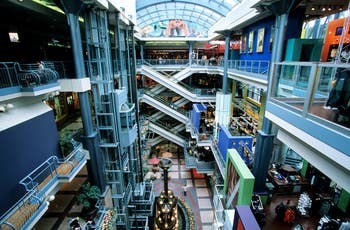
An underground mall in Montreal, Canada Photo: RENAULT Philippe / hemis.fr / AF
The psychological barrier
NOP 40 is expected to have far-reaching implications for the real estate market. In addition, in order to implement the move, an economic safety net is required to accompany it - to prevent a situation in which the underground construction will harm the economics of projects, delay them and make the apartments more expensive. In this context, the Planning Administration notes that complementary tools are being examined under the program - including tax relief and convenient loans - but these have not yet been discussed with the Ministry of Finance and the Tax Authority, which are required to approve them.
According to a survey conducted by the Planning Administration, regarding the construction costs in the underground areas and the profits they will generate in the future - in most cases the cost of construction in the underground may be about 15% higher than construction on the ground. However, when comparing the underground construction and its costs with those of the tower construction, the survey shows that the costs are equal, and the underground construction may be even more economical. The survey also shows that the main difference lies in the profits that the areas will generate - when rents of underground commercial areas may be 60% lower than commercial areas in a similar location above ground.
The costs of underground construction are also addressed by Yigal Govrin, chairman of the Association of Construction and Infrastructure Engineers, who also says that contrary to popular belief, "underground construction is not necessarily more expensive. Also, in some respects, the construction and maintenance of underground systems may be cheaper than surface construction. " They will inevitably be lower. "
Yigal Govrin, Chairman of the Association of Construction and Infrastructure Engineers Photo: Meged Guzni
The 3D law will make it possible to implement NOP 40
The emerging plan also addresses the bureaucratic barriers that have delayed the development of the underground space - and the possible solutions to them. Meanwhile, NOP 40 is expected to allow, for the first time, in some cases, the issuance of building permits by virtue of it, in a way that will allow developers to skip the detailed plans phase - which will greatly speed up the procedure.
Another significant move that precedes the formulation of NOP 40 and will enable its implementation is the 3D Law , which came into force a few months ago.
Multilayer design also brings with it developers, so the 3D law may affect the economics of underground construction. "If to this day ownership of the land extends from the depths of the earth to the heights of the sky - the law allows the ownership to be divided into layers, which will be used in various uses," explains Carmit Ulysses, head of the Ministry of Justice's real estate cluster. In projects - and generate a profit from them that will affect their finances. "