


The Marker, Hadar Horesh, 08.04.2021
Many local authorities have recently halted urban renewal projects, due to a lack of budgets required for the renewal and addition of infrastructure required in view of the expected population growth.
When mayors talk about infrastructure that the state must fund, or at least participate in a significant proportion of its costs, they mean mainly the field of education - kindergartens and schools. Generally, the state recognizes its obligation to fund most of the investment in educational institutions, and the main complaints are about delays in reaching the budget and the burden placed on municipalities as a result when they are required to train educational institutions for activity, while state funding is scarce. These cases have multiplied against the background of not transferring a state budget since 2018 and relying on a continuation budget.
But recently faced by local authorities in a new obstacle to promote urban renewal programs: Ministry of Education, responsible for transferring funds to infrastructure in the field of education, finds it difficult to adapt to the new plans - require now the municipalities to purchase or receive allocations to educational institutions in urban areas (for example, a combination of kindergartens in the plan of an existing structure , Instead of building gardens in a separate area designated for public use).
This is because according to the budget rules of the Ministry of Education, government participation in funding is given only to educational institutions built by municipalities in areas designated for public use - and not to institutions established in areas purchased or received by municipalities as part of public space transactions with developers.
CEO of the Lod Economic Company: “Lod is a crowded city and we are looking to renovate old neighborhoods. Without kindergartens, we will not be able to provide the residents with the necessary services. "
Representatives of the authorities recently sent a firm letter to the director general of the Ministry of Education, Amit Edri, in an attempt to reach an agreement that would solve the problem. In the letter - signed by Shlomo Dolberg, director general of the local government center; Eitan Atia, director of the Forum of 15 Cities in Financial Strength; .
The Ministry of Education's decision becomes critical in light of the lack of public space in urban renewal projects and new projects for dense construction. In projects of this type, there are not enough free areas on which the public buildings required for the needs of the population can be built. The problem is only expected to worsen in construction for the ultra-Orthodox population, where the demand for public buildings is higher.
In Tel Aviv they got along - but what about the rest?
One of the first examples of the integration of educational institutions within a residential complex is in Tel Aviv: in the TLV complex (wholesale market), between Carlebach and Hasmonean streets, the municipality required developers to build an elementary school and a cluster of kindergartens as part of the agreements to build the complex.
Tel Aviv-Yafo is a very rich municipality that owns expensive and sought-after land, so it could afford to establish the educational institutions in the complex without budgetary participation from the Ministry of Education - but this is an exceptional case because most local authorities in the country can not give up funding.
"The introduction of kindergartens into public buildings is critical," says Ben Miost, CEO of the Lod Economic Company, which promotes urban renewal projects in the city. "We live in a crowded city and want to renovate the old neighborhoods, which have almost no open space for public buildings. The only way is to bring the municipal services - which were previously provided in separate buildings - into the residential buildings and complexes.
"What is more natural than a combination of a kindergarten in a rental housing complex? Young families do not want to drive the child to a kindergarten on the edge of town"
"Without kindergartens, we will not be able to provide the residents with the necessary services - and we will not advance the program. If the Ministry of Education continues to insist (on funding for educational institutions built in areas designated for public buildings only; HQ), all our programs will be halted," adds Miost.
"The Ministry of Education thinks that this directive may force local authorities to build educational institutions at their own expense, to prevent the halting of construction programs - but we have no money. If the problem is not solved, construction will stop."
Meanwhile, the Bat Yam municipality is already promoting new construction plans in which kindergartens are part of residential complexes. Meir Simcha, vice president of planning and engineering at Azorim, says that according to the municipality's request, the company plans to integrate four kindergarten classes within the "Moment" project, an urban renewal complex where more than 700 new apartments will be built above a commercial and office floor. Games in the kindergarten, the children will have a playground, "says Simcha.
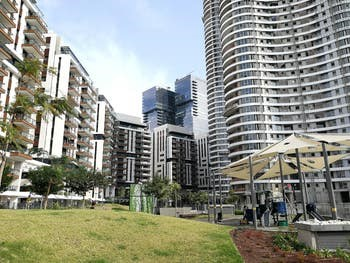
The wholesale market complex in Tel Aviv Photo: Aviva Ein-Gil
Not crowded enough
Although there are many benefits to the proximity between educational institutions and residential complexes, especially for parents and children, not all apartment buyers will be happy with the idea of living above a busy kindergarten or school. "There may be buyers who will be put off, but in a modern city, people will have to understand that it's a part of life. In any case, the entire project is built over a commercial center, and tenants get all the services in one place - including cafes, restaurants and shops under the house," says Simcha.
Despite the feeling of overcrowding in the heart of the big cities, Israel is still very far from the level of overcrowding practiced in most cities in the world, where there is no available land for building schools and kindergartens surrounded by spacious playgrounds. In cities around the world there are schools located in residential towers, and the well-fenced roof area serves as a playground and sports classes. In Israel, the first swallows are the TLV complex and another school planned inside a residential complex in Herzliya.
"We are talking mainly about kindergartens, but in the future all public buildings will be integrated into buildings and residential complexes," says Tzachi Katz, chairman of the Association of Urban Engineers and Modiin-Maccabim-Reut Municipal Engineer. Commercial, offices, residences and community services in the same complex, and sometimes in the same building. "
Although Modi'in is a relatively new city and its planning is modern, it is also beginning to feel a shortage of public space for new projects. "We have three projects in which we decided to integrate the kindergartens in the residential complex," says Katz. "What is more natural than integrating a kindergarten in a rental housing project, designed for young families who want to send the child to the neighboring kindergarten, without driving him to the other end of town? If I can expand the integration of kindergartens and schools in residential complexes we can reduce one-third Noon, "says Katz.
The Ministry of Education responded: "The ministry recognizes the importance of urban renewal, including adjustments to be made to existing buildings for educational needs. In light of this, the ministry has been working for months to review and regulate together with all relevant bodies "Educational buildings. The ministry clarifies that the building must meet the requirements of an educational building, which includes, among other things, adapted access for students with special needs and safety for students in the building. It should be emphasized that the purchase of buildings has budgetary and legal significance.
As for the letter from the 15th Forum, the ministry said that it is formulating an answer and will reply to them in an orderly manner, and that the ministry has contacted them to create a joint work. The ministry adds that so far many applications submitted for the conversion of existing buildings for education purposes have not met the threshold requirements required for educational buildings.