


The Marker, Adi Cohen, 05.05.2021
The trick of the Tel Aviv Municipality: About six years after imposing restrictions on the conditions for issuing building permits in the heart of the city, and just before the restrictions expire, the municipality found a creative way to exploit a loophole in the law that would allow it to continue applying the restrictions indefinitely.
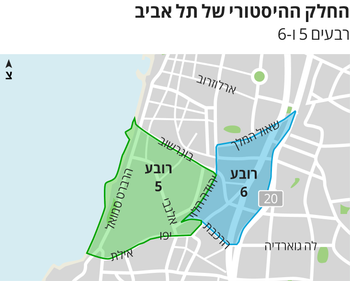
In 2015, the Tel Aviv Municipality began to formulate the detailed plans for Quarters 5 and 6. These are intended to regulate the planning regime in the historic heart of the city, and to determine the maximum building rights that can be obtained in urban renewal projects and NOP 38 in these areas - including the Lev Tel Aviv neighborhoods and Allenby and Rothschild streets, Sharona Gardens, Montefiore and Yemenite vineyards.
"Economically, the planning change that the municipality initiated could mean an additional profit of hundreds of thousands of shekels for the project."
The appraiser Itzik Rafael
In the same year, the municipality tightened the conditions for issuing building permits in the two quarters - in accordance with sections 77 and 78 of the Planning and Building Law - until the publication of the detailed plans. These sections make it possible to freeze building permits, in order to prevent a situation in which the permits will thwart the implementation of the plans that are being prepared in the future. These restrictions on the issuance of permits were to expire in the coming weeks, after the municipality extended them again and again and stretched their use to the limit - to the point that the law no longer allows it.
However, the Tel Aviv municipality - which has not yet completed the preparation of the desired plans and their approval by the district committee - has found a loophole in the law that will allow it to apply a new planning policy to the city center, probably as early as August.
The good news as part of the emerging policy, which will be approved by the local committee in the coming week, is an update by the municipality that defines in detail the building volumes, density, height restrictions and building lines allowed in each area within the boundaries of quarters 5 and 6.
On the one hand, the industry welcomes a certain release of restrictions and at least the partial certainty that the new policy is expected to impart. On the other hand, it was argued that the move does not promote plans that grant actual building permits - but rather prepares the creeping of planning procedures for quarterly plans for an unknown or limited time.
A policy document is a planning tool that cannot be used to issue building permits, but only to request specific plans based on it. Hence, the municipality still does not provide the certainty that the quarterly plans, which were supposed to be published years ago, are given.
The good news: the addition of building rights to plots
Many of the clauses in the new policy are a direct continuation of the temporary principles outlined by the Tel Aviv Municipality under the restrictive conditions it has applied so far, with the exception of a few amendments. With the amendments that include the policy that will be brought to the committee's approval, it is also a significant line for developers and apartment owners, regarding the density levels. Apparently, the method of calculating the building density in the heart of the city will soon change in a way that will increase the permitted construction volumes.
For example, today the density is fixed in each area individually, and it is usually possible to easily approve the addition of housing units of only up to 20% of the permissible density - but from now on there will be a fixed density coefficient. "As the local committee increases the density it allows entrepreneurs to increase the revenue and profit from projects," says appraiser Itzik Rafael from the firm of Kamil Trashansky Rafael. He emphasizes that this is not an addition of space, but of the number of housing units in the same lot.
Anat Biran. "Policy documents will cause licensing procedures to be extended and construction reduced" Photo: Eyal Toug
"In this way, more small apartments can be included in the construction - which are sold at a higher price per square meter. Economically, the change could mean an additional profit of hundreds of thousands of shekels for the project. In the existing situation with the restrictive conditions, up to nine housing units can be built on a 500-square-meter plot. However, according to the new policy and the established coefficients, you can build 11.5-12 apartments of different sizes in the same plot. "
Restrictive policy
The plans for Quarters 5 and 6, which have been worked on by the Tel Aviv Local Planning Committee since 2015, are detailed plans that continue to the plans for Quarters 3 and 4, which were approved in 2016. These plans are intended to provide planning certainty and regulate building rights in urban renewal projects in the heart of the city - from Bograshov and King Saul streets in the north; To Yitzhak Elchanan, Aharonson, Ahad Ha'am and Menachem Begin in the south; From Hayarkon Street in the west; And to Begin Road, Shprintsak, Laskov and Dubnov to the east.
The restrictive conditions for issuing building permits throughout the planning area published by the municipality in 2015 have been updated and extended several times since then, and are expected to expire in about two weeks. Meanwhile, the municipality has managed to postpone once and for all the expiration of the restrictions, as provided by law - to August. However, it seems that even then the municipality does not intend to approve the quarterly plans. Instead of the plans, the new municipal policy should take effect.
"Problematic planning regime"
"On the practical and positive side, the new policy is quite detailed, which provides entrepreneurs with a better understanding of their limitations and rights in projects, and it will create more planning certainty," says Adv. Nitzan Zimran, a partner at Ofer Twister & Co. Very problematic: this policy produces a detour to limit the time that the law sets for the restrictive conditions in the demand areas. "And all this only because the municipality fails to meet the legal limit and the district commission's requirement to approve the plans," Zimran explains.

A building on Nachmani Street. From now on, there will be a constant density coefficient in Tel Aviv Photo: Moti Milrod
Advocate Anat Biran sees things in a similar way: "In general, the whole issue of policy documents is an instrument that bypasses statutory planning, which unfortunately the courts have given legitimacy to. Unlike plans, when it comes to municipal policy there is no procedure of public participation or of hearing objections - and what the committee decides is in fact what the policy says.
"Ostensibly, because this is not a plan, municipal policy is not binding, but is still quite complex to promote permit applications that deviate from the policy, and this usually rolls into lengthy and costly procedures up to the appeals committees," she adds. "In the end, all the policy documents lead to an extension of licensing procedures, a reduction in construction and supply - and this has a direct link to price increases and a reduction in construction starts and urban renewal processes in the most sought-after area in the country."
Byrne also refers to the creep in approving Quarters 5 and 6 plans: "In the situation that has arisen, a question mark arises as to whether the municipality does not intentionally approve the plans, and waits for the NOP to disappear from the world - so that when approved, the plans will not include the relief."
Some developers add that beyond the issue of constraints and planning uncertainty, due to the existing urban chaos - with the light rail and metro plans - it is also difficult to promote urban renewal projects.
Tel Aviv Municipality. "The Quarters 5–6 plan is much more complex than other plans approved in the city center" Photo: Meged Guzni
"Complex program"
The Tel Aviv-Yafo Municipality stated that: "The Quarters 5-6 plan is much more complex than other plans approved in the city center, due to statutory legal issues, and therefore the time for approval is longer. Extensive activity in this field.
"As for claims regarding a policy document against restrictions under section 77-78 of the law - these are two different statutory tools, but in the essence of the planning there is no difference between them. Regarding expiration of NOP 38, we monitor developments in the matter and act according to government decisions."